
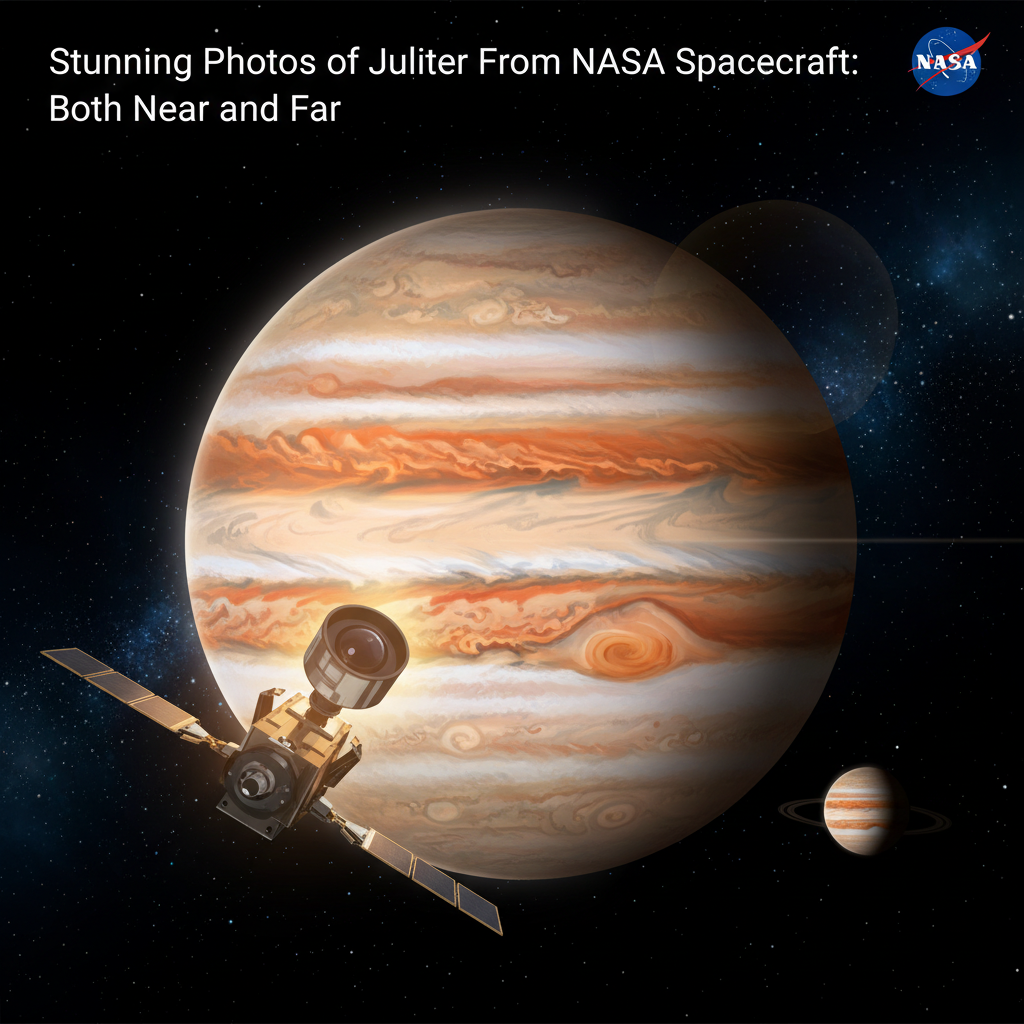
Explore breathtaking photos of Jupiter from NASA spacecraft, from the distant snapshots of Voyager and Hubble to Juno’s spectacular close-up images.
The Majesty of Jupiter Through NASA’s Lenses
Jupiter, the undisputed king of our solar system, has captivated astronomers for centuries. However, it wasn’t until the dawn of the space age that we could truly appreciate the gas giant’s complex beauty. Photos of Jupiter from NASA spacecraft, both near and far, have revolutionized our understanding of its swirling atmosphere, colossal storms, and intriguing moons. Let’s embark on a visual journey through the history of NASA’s missions to Jupiter.
Far-Flung First Impressions: Pioneer and Voyager
Before spacecraft could orbit Jupiter, they had to fly by. The Pioneer 10 and 11 missions gave us our first close-ish glimpses in the early 1970s. However, it was the Voyager 1 and Voyager 2 spacecraft in 1979 that truly delivered iconic, high-resolution photos of Jupiter from afar. These missions captured the complex, banded structure of Jupiter’s cloud tops, the first detailed images of the Great Red Spot, the discovery of Jupiter’s faint ring system, and active volcanism on the moon Io.
The Galileo Era: The First Orbiting Photographer
In 1995, NASA’s Galileo spacecraft became the first probe to orbit Jupiter. For nearly eight years, Galileo took thousands of photos from a relatively near vantage point compared to Earth-based telescopes. Galileo’s camera provided deep insights into the atmospheric dynamics of the planet and captured stunning close-ups of Europa’s icy surface, hinting at a vast subsurface ocean.
The Cassini Flyby: A High-Def Glimpse
While en route to Saturn in 2000, NASA’s Cassini spacecraft performed a gravity-assist flyby of Jupiter. The photos of Jupiter from this NASA spacecraft are some of the highest-resolution global portraits ever taken. Cassini’s distant yet incredibly sharp viewpoint allowed scientists to stitch together stunning true-color mosaics, revealing the intricate atmospheric belts and zones in unprecedented detail.
Up Close and Personal: The Juno Mission
If previous missions showed us the face of Jupiter, NASA’s Juno spacecraft, which arrived in 2016, is practically skimming its nose. Placed in a highly elliptical polar orbit, Juno dives closer to Jupiter’s cloud tops than any previous mission. The JunoCam instrument has delivered arguably the most dramatic, near-field photos of Jupiter ever seen. Highlights from Juno include:
- Spectacular, swirling cyclonic storms at the planet’s poles.
- Deep atmospheric plunges directly over the Great Red Spot.
- High-contrast, vividly processed images created by citizen scientists using raw JunoCam data.
Distant Watchers: Hubble and James Webb
Not all iconic photos of Jupiter from NASA spacecraft require traveling to the Jovian system. Space telescopes operating from Earth’s orbit or Lagrange points offer spectacular ‘far’ views that continuously monitor the planet’s changing weather. The Hubble Space Telescope’s Outer Planet Atmospheres Legacy (OPAL) program provides annual portraits of Jupiter, tracking changes in the Great Red Spot and the emergence of new storms. More recently, the James Webb Space Telescope turned its infrared gaze toward Jupiter, capturing ethereal images of its auroras, rings, and faint moons, proving that even from afar, we can still discover new Jovian secrets.
Conclusion
From the fleeting flybys of the 1970s to the daring orbital dives of today, photos of Jupiter from NASA spacecraft have continuously reshaped our cosmic perspective. Whether captured from billions of miles away by a space telescope or just a few thousand miles above the swirling clouds by a dedicated orbiter, these images stand as a testament to human curiosity and technological achievement.